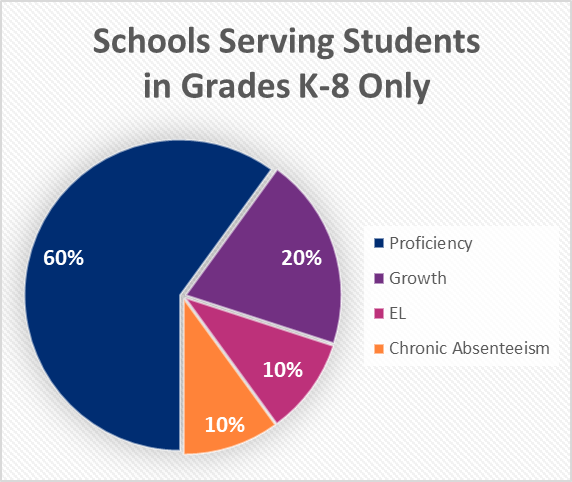
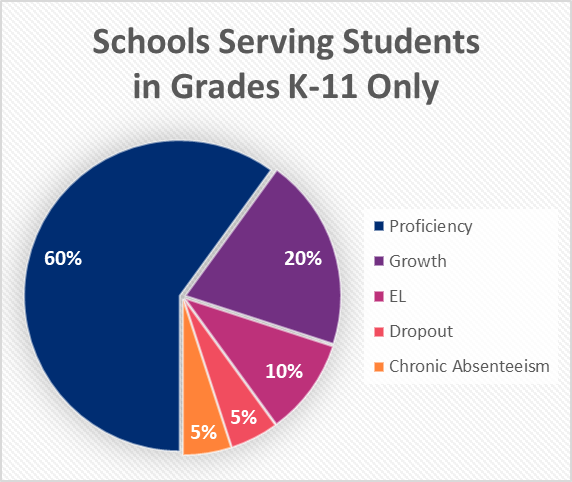
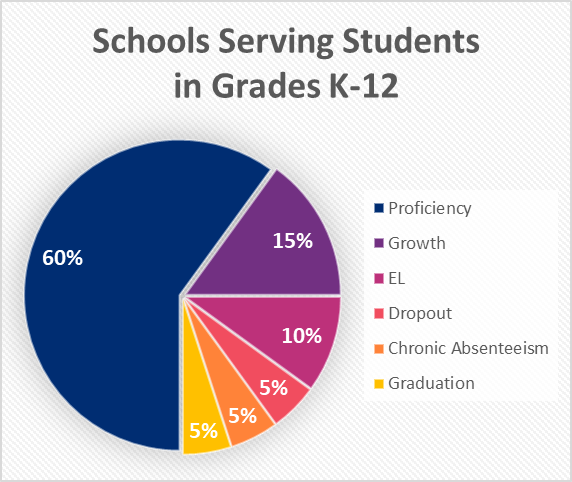
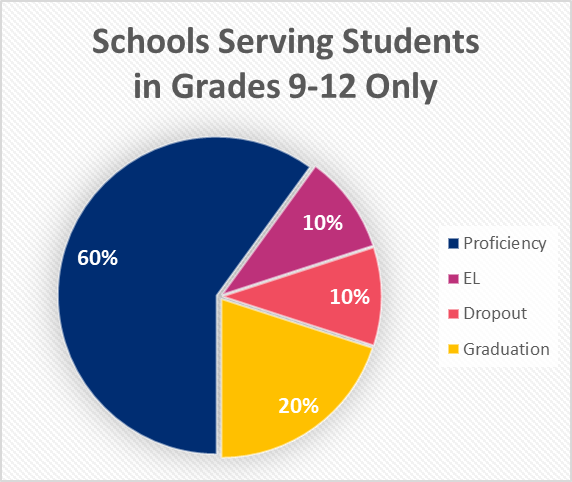
The Federal Every Student Succeeds Act (ESSA) requires states to identify schools for Comprehensive Support and Improvement (CSI) for overall low student achievement and low graduation rate, Additional Targeted Support and Improvement Schools (ATSI) for low subgroup achievement, and Targeted Support and Improvement (TSI) for schools with consistently underperforming subgroups.
These models require schools to have a minimum of twenty students in each indicator to be eligible to earn the points. Schools that do not meet the minimum student threshold cannot earn points for that indicator. Schools that do not meet the population threshold for the Proficiency indicator do not receive a valid Comprehensive or Subgroup Achievement Score (CAS or SAS) and are identified using alternate methodology.
| Component | Weight | Description |
|---|---|---|
| Proficiency | 60% | Arizona State Assessment and Alternative Assessment in both English Language Arts and Math. |
| EL | 10% |
Proficiency on English Learner Assessment: School's percentage of students proficient compared to the average K-8 EL Proficiency. Growth on English Learner Assessment: School's change in performance levels compared to the average K-8 change in performance levels in the current year. |
| Growth | 20% |
Student Growth Percentiles: Student performance on English Language Arts and Math in the prior school year and their growth in the current school year is compared to their academic peers. |
| Chronic Absenteeism | 10% | Percent of Students who did not miss more than 10% of the days in the current school year. |
| Component | Weight | Description |
|---|---|---|
| Proficiency | 60% | Arizona State Assessment and Alternative Assessment in both English Language Arts and Math. |
| EL | 10% |
Proficiency on English Learner Assessment: School's percentage of students proficient compared to the average 9-12 EL Proficiency. Growth on English Learner Assessment: School's change in performance levels compared to the average 9-12 change in performance levels in the current year. |
| Growth | 20% |
Student Growth Percentiles: Student performance on English Language Arts and Math in the prior school year and their growth in the current school year is compared to their academic peers. |
| Chronic Absenteeism | 5% | Percent of Students who did not miss more than 10% of the days in the current school year. |
| Dropout | 5% | Percent of Students who did not drop out during the school year. |
| Component | Weight | Description |
|---|---|---|
| Proficiency | 60% | Arizona State Assessment and Alternative Assessment in both English Language Arts and Math. |
| EL | 10% |
Proficiency on English Learner Assessment: School's percentage of students proficient compared to the average K-8 and 9-12 EL Proficiency. Growth on English Learner Assessment: School's change in performance levels compared to the average K-8 and 9-12 change in performance levels in the current year. |
| Growth | 15% |
Student Growth Percentiles: Student performance on English Language Arts and Math in the prior school year and their growth in the current school year is compared to their academic peers. |
| Chronic Absenteeism | 5% | Percent of Students who did not miss more than 10% of the days in the current school year. |
| Graduation | 5% | Percent of students from a school's 4-year graduating cohort that graduated. The 4-year graduating cohort data is lagged by one year. |
| Dropout | 5% | Percent of Students who did not drop out during the school year. |
| Component | Weight | Description |
|---|---|---|
| Proficiency | 60% | Arizona State Assessment and Alternative Assessment in both English Language Arts and Math. |
| EL | 10% |
Proficiency on English Learner Assessment: School's percentage of students proficient compared to the average K-8 and 9-12 EL Proficiency. Growth on English Learner Assessment: School's change in performance levels compared to the average K-8 and 9-12 change in performance levels in the current year. |
| Graduation Rate | 20% | Percent of students from a school's 4-year graduating cohort that graduated. The 4-year graduating cohort data is lagged by one year. |
| Drop out | 10% | Percent of Students who did not drop out during the school year. |